
There were a large number of Pathan Riasaten (kingdoms) in the Indian Subcontinent but only 21 survived the upheaval of 1857 and were recognized as States by the British. While Amb, Dir and Swat were situated in the northwest, the majority were in Punjab and United Province (UP), with a few in Rajasthan and elsewhere. One of those that didn’t survive was the riasat of Najibabad which lay in the northwestern corner of Awad (present UP).
Sahabzada Yaqub Khan traced his Pathan ancestry to Nawab Najibud Daula a.k.a Najib Khan who was a Yusufzai Rohilla of the Umar Khel clan. In 1739 he travelled to Rampur from Swabi, near Mardan, and joined his uncle, Bisharat Khan, who was serving Nawab Ali Muhammad Khan, a Rohilla chieftain. In 1743 he was appointed Jamadar and married the daughter of Dundey Khan another Rohilla chieftain. He served his father-in-law well both politically and militarily and was awarded 14 Parganas (in present days, a Pargana is equivalent to a tehsil or group of villages). In 1751 he took a leading role in fighting against the forces of Safdar Jang who had driven the Rohillas into the Kumaon Hills and was awarded the command of 1000 soldiers.
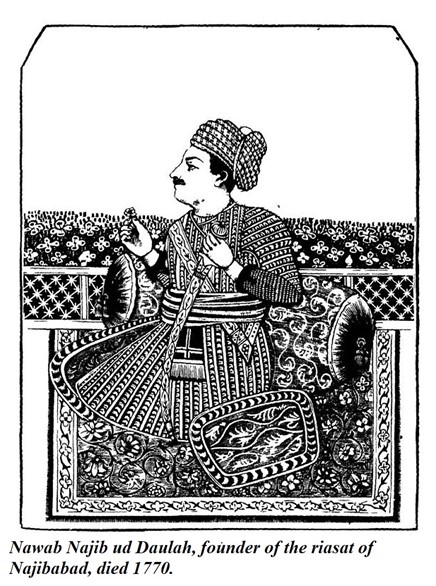
Safdar Jang (1708 – 1754), was a major figure at the Mughal court during the declining years of the empire and in 1739 he was appointed the second Nawab Vizier of Awadh. He rebelled against the emperor and with the help of the Jats, besieged Shahjahanabad (as Delhi was renamed). The emperor was anxious to obtain help from the Rohilals but under a threat from Safdar Jang their sardars remained neutral. Najib Khan scorned their cautious and timid policy and went to the assistance of the emperor. By this one act, he rose from being a dependent of the Rohilla sardars to a leading political and military figure in Northern India. He was received by Emperor Ahmed Khan in June 1753 and was granted the title of Najibud Dulah and the mansab (command) of das hazar (ten thousand) troops. He successfully fought off the besiegers and negotiated an end to the siege for which he was further honored by the emperor.
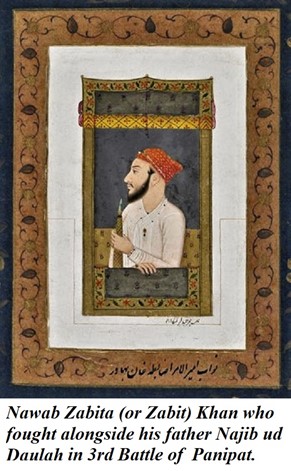
The main battle was a clash between the heavy artillery and cavalry of the Marathas against the heavy cavalry and the more mobile mounted artillery (zamburak and jezail) of the Afghans and Rohillas. Fortunes ebbed and flowed and at one stage the Maratha army nearly achieved a breakthrough in the center and right. However, Najib’s troops on the left held, and Abdali committed his reserves to turn the tide. The Maratha soldiers were too exhausted to resist because their army had been surrounded for days and was starving. Following his victory, Abdali returned to Afghanistan never to return but did not appoint Najib as vizier to the Emperor because too many powerful chiefs were jealous of him, and Najib could not be manipulated. For the next decade till his death, Najib continued with his diplomatic and military skills to maintain his position in the court of the emperor as well as his governorship of Saharanpur and was bestowed the title of Nawab. He ultimately succeeded Safdar Jung as vizier.
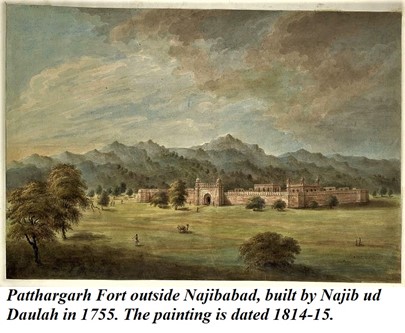
In March 1768, Nawab Najib-ud-Daula retired his leadership over the Rohillas and declared his son Zabita Khan as his successor, who had fought alongside him during the Battle of Panipat. Two of Najib’s high-ranking officers resisted but were crushed by Zabita Khan. The following year, Najib took his son to Delhi, where Zabita Khan was hosted by the Dowager Empress and the Crown Prince. On his death in 1770, he was buried in Najibabad, a town that he founded in Bijnor District. Its site was selected to facilitate the trade with Kashmir since the passage through Punjab had been made unsafe by the inroads of the Sikhs, Marathas, and Afghans.
At the time of his father’s death, Zabita Khan was believed to be the second richest person in northern India after the Jat King and was invested as Mir Bakhshi (Head of the Mughal Army) by Shah Alam II. However, he did not have his father’s diplomatic or military skills and after he lead several rebellions by the Rohillas, Shah Alam II began a military campaign against him with the support of the Marathas. During this campaign his son Ghulam Kadir, aged eight was captured in 1777 in Ghausgarh in the Saharanpur District, while his father managed to escape. Kadir was finally sent back to his father, who had regained the imperial favor and was re-established as Mir Bakhshi.
The life of Ghulam Kadir is not a pretty story. It is replete with violence, treachery revenge, and cruelty and does not deserve to be covered in any detail. In brief, he forced the emperor to give him the same status as his father and grandfather, departed from Delhi when his court intrigues failed only to return to depose and blind the emperor as revenge for the ill-treatment he received as a boy. Kadir also humiliated the emperor’s family and put to sword 21 princes. He is the subject of a poem by Allama Iqbal titled Ghulam Qadri Rohilla that portrays the cruelty of the Rohailla but the underlying message is about the loss of courage and self-respect by the Mughals. After sacking Delhi, Kadir fled from the advancing Maratha army but was captured and at the request of Shah Alam, was horribly mutilated and died in 1788.
After the death of Kadir, his brother Ghulam Muin ud-din Khan fled to Punjab. He returned 24 years later in 1812 at the invitation of the East India Company which by now had occupied Awadh. Muin ud-din Khan was allowed to settle in Najibabad with the title of Nawab and granted a pension of Rs. 5,000 per month. He died in 1843, and his title passed onto his son Nawab Mahmud Khan. During the events of 1857, he and his brother rebelled and occupied Bijnor but were defeated in 1858. Mahmud Khan was jailed in Meerut where he died the same year and his brother Nawab Muhammad Jalal ud-din Khan was hanged for complicity. Jalal ud-din’s first marriage had been to a lady from Rampur and she along with his second wife and the children fled and were given shelter by her kinsmen and rulers of Rampur.
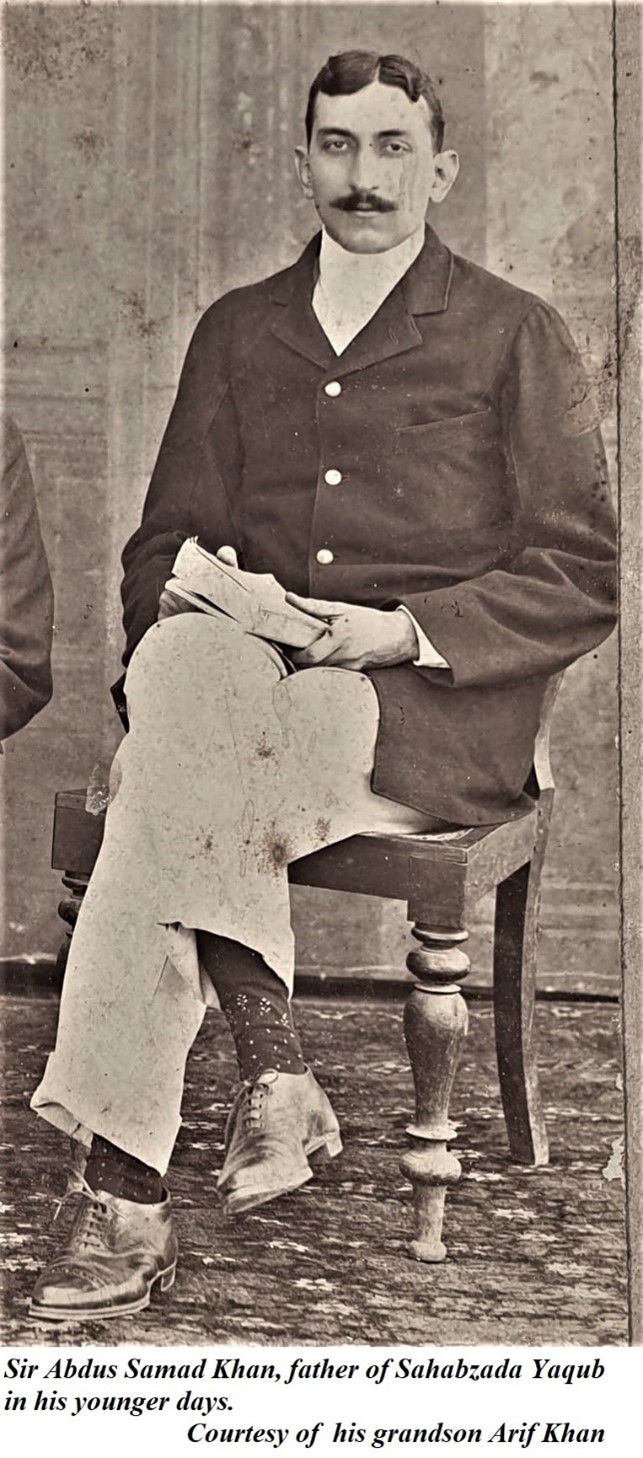
When the 21-year-old nawab was invested with ruling powers, he appointed Abdus Samad as his Private Secretary and in 1900, elevated him to the post of Chief Secretary which he continued to hold for 29 years. Sir Samad was a man of stature and represented the Princely States at the Round Table Conferences in London in 1931 and 1932. He also attended the Imperial Economic Conference in Ottawa in 1932 and the League of Nations in 1933. Sir Samad was married to the daughter of General Azimuddin but she passed away after bearing a daughter who became the wife of the Nawab. His second wife was Aliya Sultan Begum of Loharu who had links to the family of the famous poet Mirza Ghalib. They had two daughters and three sons and Sahabzada who was born in Rampur on 23 December 1920 was the youngest. All three brothers had names that began with the letter ‘Y’ – Yunus, Yusuf, and Yaqub. After serving the State of Rampur for over 40 years, in 1937 Sir Samad accepted the appointment of Home Minister of the State of Jammu & Kashmir. He died in 1943 at the relatively young age of 69 while Sahabzada Yaqub was a Prisoner of War in Italy.