
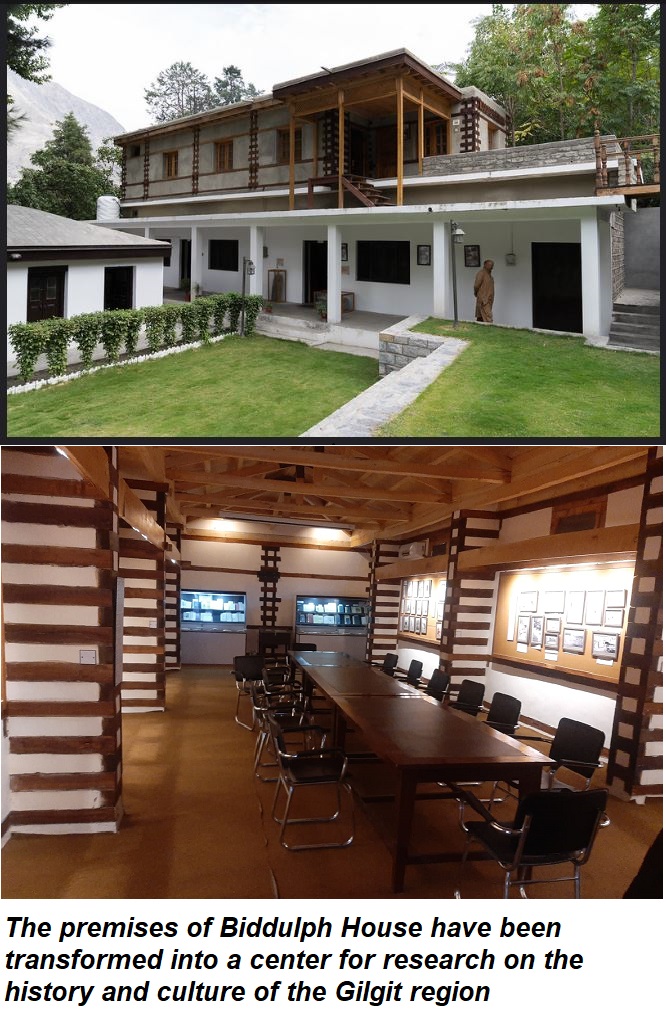
Within the shadows of the Great Game played out by the British and Russian Empires in the late 1800s, there were two havens for Europeans: Chini Bagh (the Chinese Garden), the residence of the British Consul to Kashgar, and the Agency Bungalow in Gilgit. Explorers, archeologists, army officers ostensibly out hunting for trophies, cartographers, spies, and bonafide diplomats savored a touch of ‘civilization’ before again heading out on their wearisome and risky journey. The Agency Bungalow was the residence of the Political Officer / Political Agent who was responsible for managing the affairs of the principalities and ensuring that the interests of the Crown were safeguarded. However, the Maharaja of Kashmir was initially very reluctant to permit a British officer to be stationed in Gilgit and after the Treaty of Amritsar in 1846. under which the British sold the territories of Kashmir to Gulab Singh, it took 40 years for the State of Kashmir to accept a permanent Political Officer in Gilgit, and another 46 years for the post to be upgraded to that of a Political Agent.
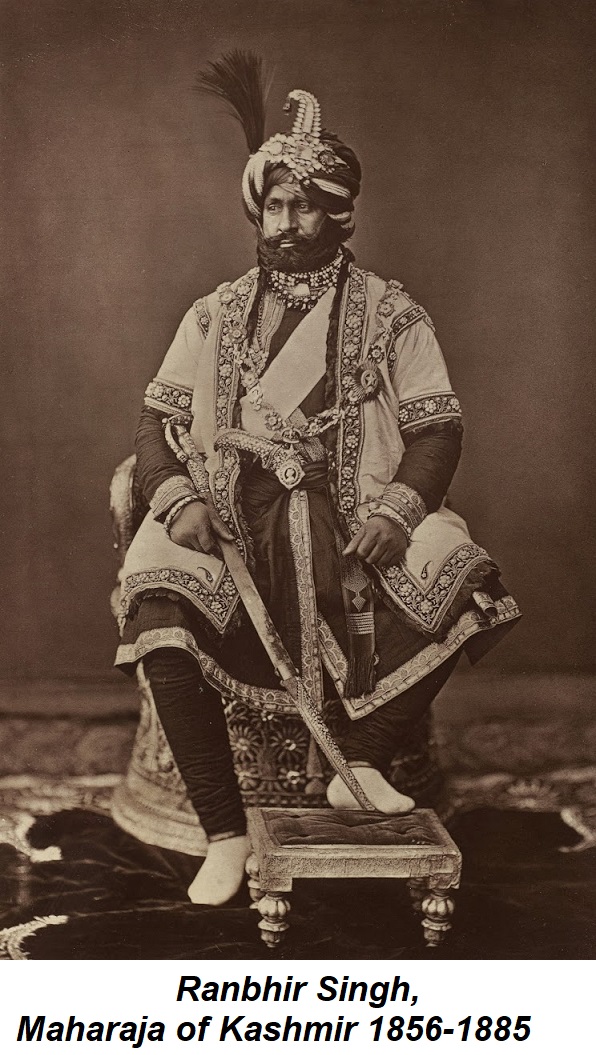
Since the British lacked information about the physical and political geography north and east of River Indus, the treaty stated that the northern and eastern borders of the State of Jammu and Kashmir (J&K) would be defined after a survey. In the meantime, the Maharaja claimed Gilgit because it was part of the Sikh territories but his garrison was annihilated in 1852 when Gilgit rebelled. However, while the British were preoccupied with consolidating their rule after the events of 1857, Gulab Singh’s successor, Ranbir Singh retook it in 1860 and extended his authority to the Dardi states of Chilas, Darel, Nagar, Yasin, Punial, Ishkuman, and Astor. He also extended his suzerainty over Hunza, which was strategically the most important as it commanded the routes from Eastern Turkistan through the passes of Mintaka, Khunjerab, and Shimshal.
Ranbir Singh sought to pursue an autonomous foreign policy and forge trade relations with Eastern Turkistan and Afghanistan. The Treaty of Amritsar had imposed no restrictions on this matter. However, as the Russians began expanding into the region, the British grew apprehensive about Ranbir’s intentions. Their unease heightened when the Maharaja established a military post across the Karakoram along the Leh-Kashgar trade route. A very vibrant trade existed from Central Asia into Srinagar through Leh and Gilgit and the Maharaja may only have been protecting it from marauders but the British perceived it as an endeavor to extend his northern borders. Adding to their concerns, a member of the Kashmir Survey Party formed in 1855, marked on official British Indian maps the north-eastern frontier of the State well into the Trans-Karakoram region. The British censured the surveyor and informed the Maharaja that the revised limits were unacceptable. They also stationed an agent in Leh to closely monitor developments.
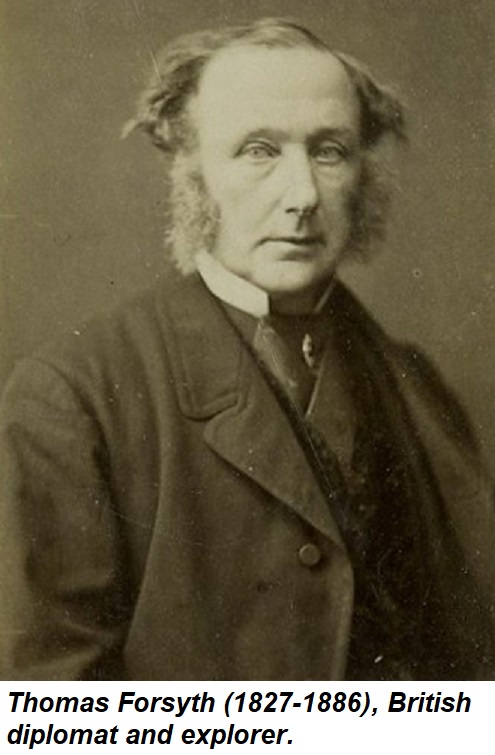
Between 1870-73, the government sent Douglas Forsythe on two missions to Yarkand to establish diplomatic relations with Yaqub Beg, the separatist anti-Chinese ruler, and explore trade opportunities. He was also tasked to gather information. On return from his second mission, Forsythe reported that the Ishkoman and Baroghil Passes (the two principal passes of the great mountain range separating the valley of the Oxus from Chital and Yasin), were easily passable by troops, implying the possibility of a Russian invasion. The Russians had captured Tashkent in 1865 and within a decade subjugated the whole of Western Turkistan and pushed their frontier closer to British India. Consequently, Forsythe’s information created shockwaves in London and when Lord Lytton was appointed as viceroy in 1876, he was instructed to view the frontier administration as an ‘imperial concern’ and take appropriate measures to achieve the ‘imperial objectives’.
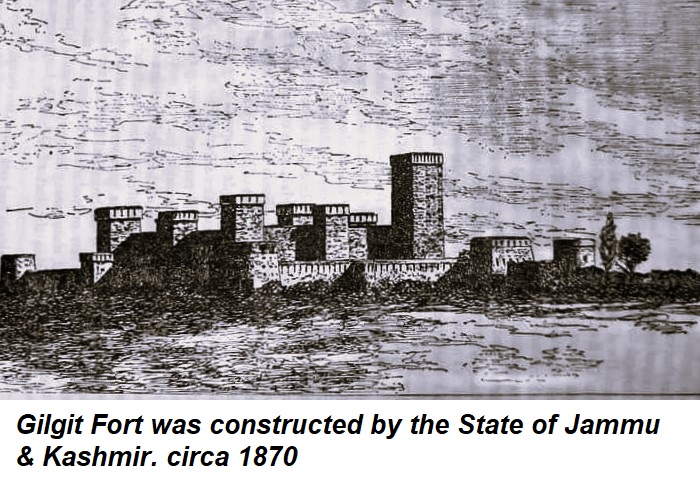
Of immediate concern was the vulnerability of the Dardi principalities of Hunza, Nagar, Chials, Yasin, Punail, and others. The valley of Gilgit was not a principality but was invaded and seized by either one or the other neighbors. Lord Curzon termed Gilgit the Northern Gate of India because all the routes through the eastern passes over the Hindu Kush dropped down into the valley of the Gilgit River and its tributaries. It also commanded the approach from Chitral over the Shandur.
Through extensive negotiations with the Maharaja conducted at Madhopure in Nov 1876, Lord Lytton attempted to formulate a new Kashmir policy that would address the ‘imperial objectives’ in the region without incurring additional costs. In the opening meeting, Lord Lytton stated that the rapid march of events in Central Asia made it necessary for the government to take certain measures to ensure peace and security on its borders. He desired that the country beyond the borders of Kashmir should come under the control of the Maharaja rather than powers inimical to Kashmir. The Maharaja would be allowed to extend his authority over the frontier principalities particularly Chitral and Yasin, not with force but through political negotiations aided by the British. In return, he would permit a British agent in Gilgit and British troops when required.
The negotiations nearly broke down because Ranbir Singh was strongly against the appointment of an agent as he feared ‘high-handed interference in domestic matters’. He ultimately agreed only if the government gave him written assurances in the form of a sanad that contained 12 conditions limiting the role and powers of the agent. A month later the Viceroy approved these conditions and conveyed that the function of the officer stationed in Gilgit would be confined to providing information regarding the frontier and beyond and providing advice to the Maharaja and the Government at Calcutta. He would also with approval by the Maharaja cultivate friendly relations with the tribes to bring them under the control and influence of Kashmir and finally, he would assist in organizing military measures on the border. However, the British remained quiet on the maharaja’s condition that the agent would be based only in the summer months.
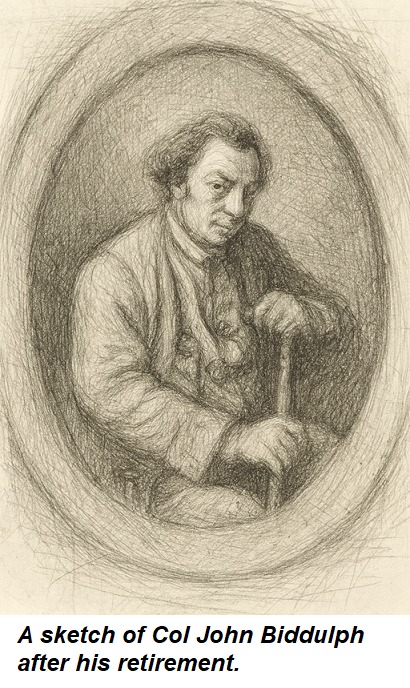
In 1877 the British placed Capt John Biddulph, as Officer on Special Duty in Gilgit. He was very familiar with the region since he had been a member of Forsythe’s mission to Yarkand. It was a difficult period as not only was Afghanistan bending towards the Russians, but it also wanted to seize Chitral. This could provide the Russians access to the frontiers of British India. Sandwiched between Afghanistan and Kashmir, Aman-ul-Mulk, the Mehtar of Chitral had accepted the suzerainty of both to get as much subsidy and aid. However, this duality was not acceptable to the British who pressured the Maharaja to bind Chitral into a formal agreement. This resulted in the Kashmir-Chitral Treaty of 1878 in which the Mehtar agreed to obey and execute the orders of the Maharaja in return for an annual of Rs. 12,000.
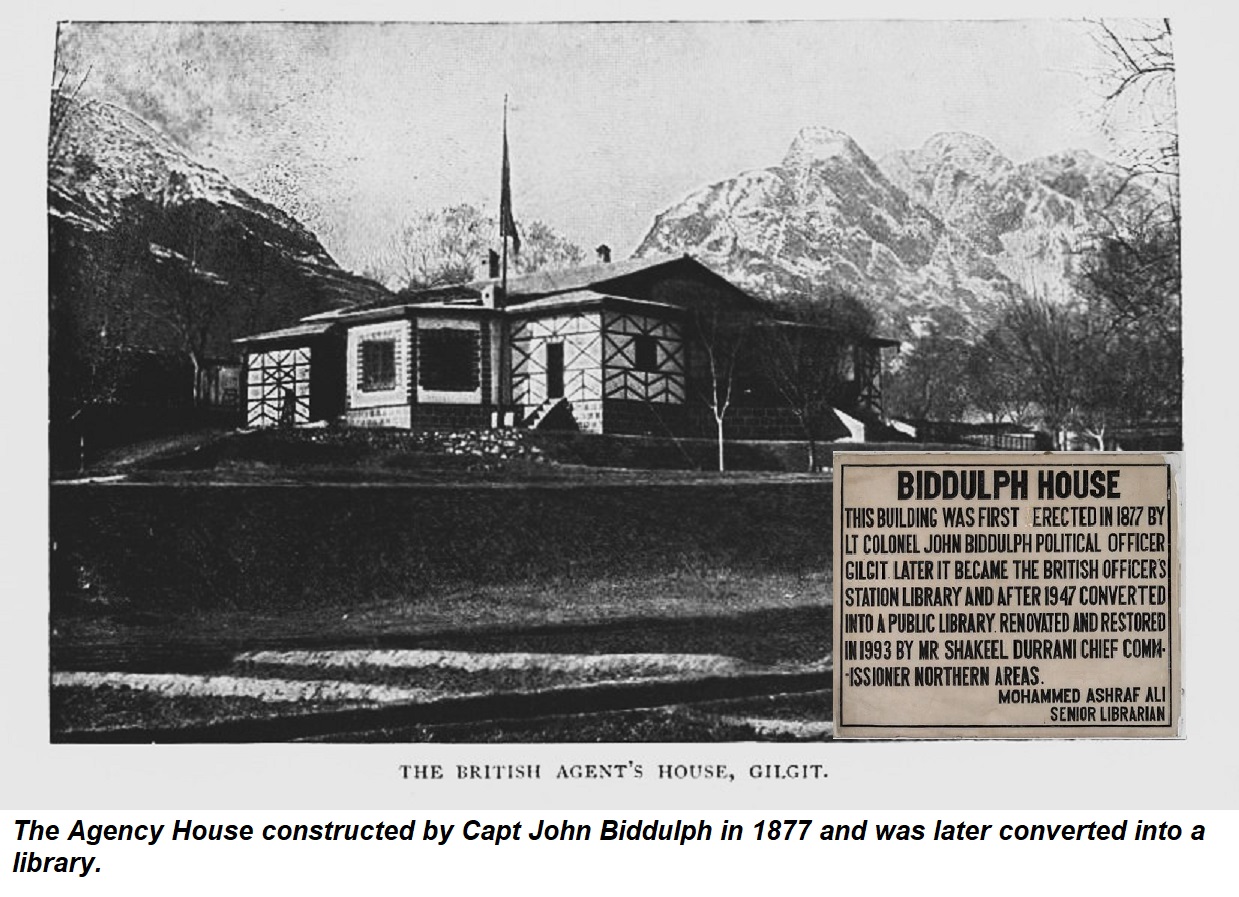
However, the Mehtar continued to vacillate, and with the relationships between India and Afghanistan heading closer to war, Biddulph visited Chitral to determine the sincerity of Aman-ul-Mulk and returned convinced of his treachery. In Mar 1879, he recommended that attempts to secure Aman’s allegiance should be abandoned. Meanwhile, Biddulph completed the construction of an Agency House in Gilgit with Tudor Revival architecture and it continues to bear his name. In 1948, Biddulph House was converted into a public library and has recently been upgraded into a center for research into the history and culture of the region.
By now the Second Afghan War was in full cry and the British were close to occupying Kabul for the second time. Consequently, the frontier territories of Kashmir were for the time being at a low priority but Biddulph continued to the best of his ability to win over the tribal chieftains. However, he was unsuited for the task because of his method and style which turned the chieftains against him as well as the Dogra rulers of Kashmir. Lord Rippon who was appointed viceroy in 1880, opposed the ‘Forward Policy’ of his predecessor and in July 1881, after four years, the agency was terminated leaving the security of the northern frontier in the hands of the Maharaja.
The Russian occupation of Central Asia continued unabated. Khiva had been captured in 1878 and by 1885 the whole of the Turcoman region. By 1886, Britain and Russia had delineated the border of Afghanistan thereby blocking any further ingress southwards, but the Russians had also been probing into eastern Turkmenistan. They had been mapping the Pamirs and entered into the Tarim Basin. At the time of Yakub Beg both Russian and British agents were active at his court.
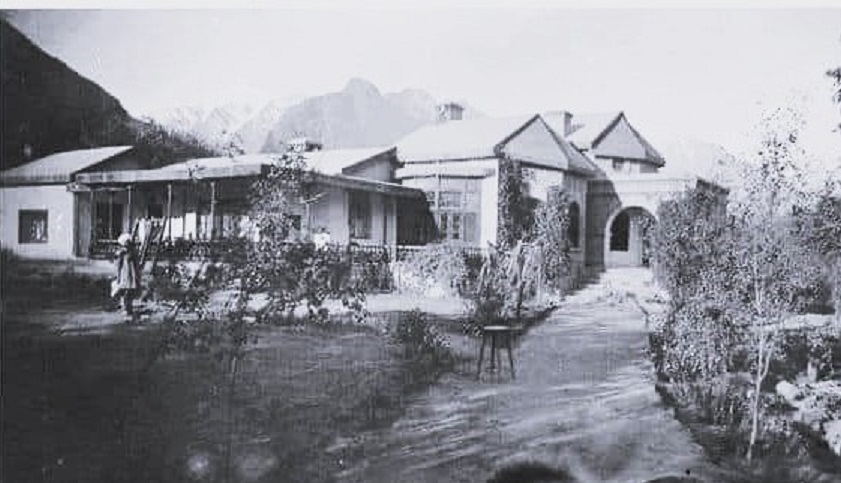
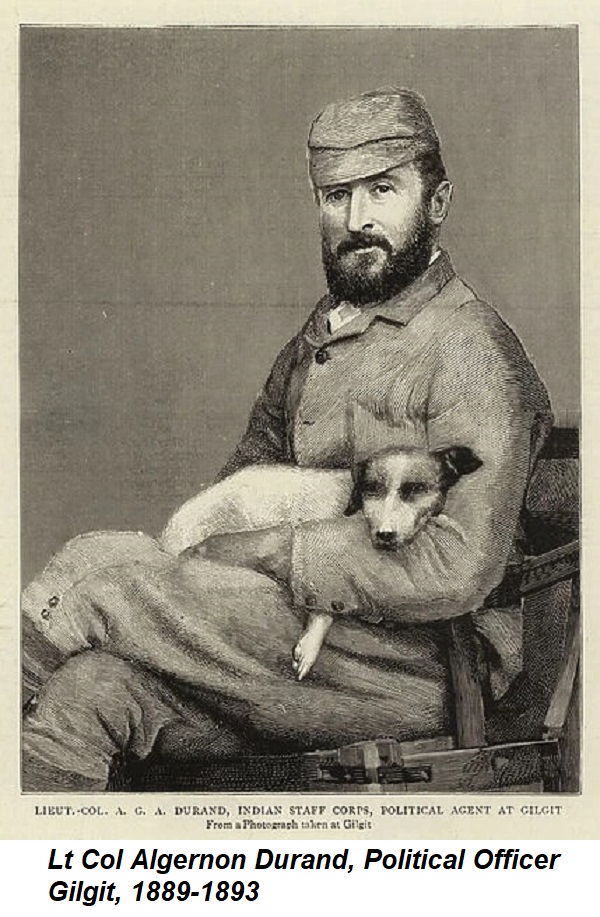
In 1884 Lord Dufferin became the viceroy and his closest friend and advisor was Sir Mortimer Durand, Foreign Secretary to the Government of India. Mortimer strongly believed in a revival of the Forward Policy and in 1887 wrote a memo recommending that the tribes of the Hindu Kush be brought under control to open up the area for the movement of troops. A year later combined forces of Hunza and Nagar overwhelmed a large Kashmiri force in a battle at Chaprot west of the valley and took many prisoners. In 1888 Col Algernon Durand, the brother of Mortimer Durand and author of ‘Making of a Frontier’, was sent on a mission to Gilgit to determine the reason for these hostilities and while returning after a month in Chitral he heard that a Russian officer had visited Hunza. This alarming information coupled with the defeat of the State troops, triggered the government to take immediate action and in 1889, a full seven years after its termination, the agency was reopened and Algernon was selected for this post along with two assistants.
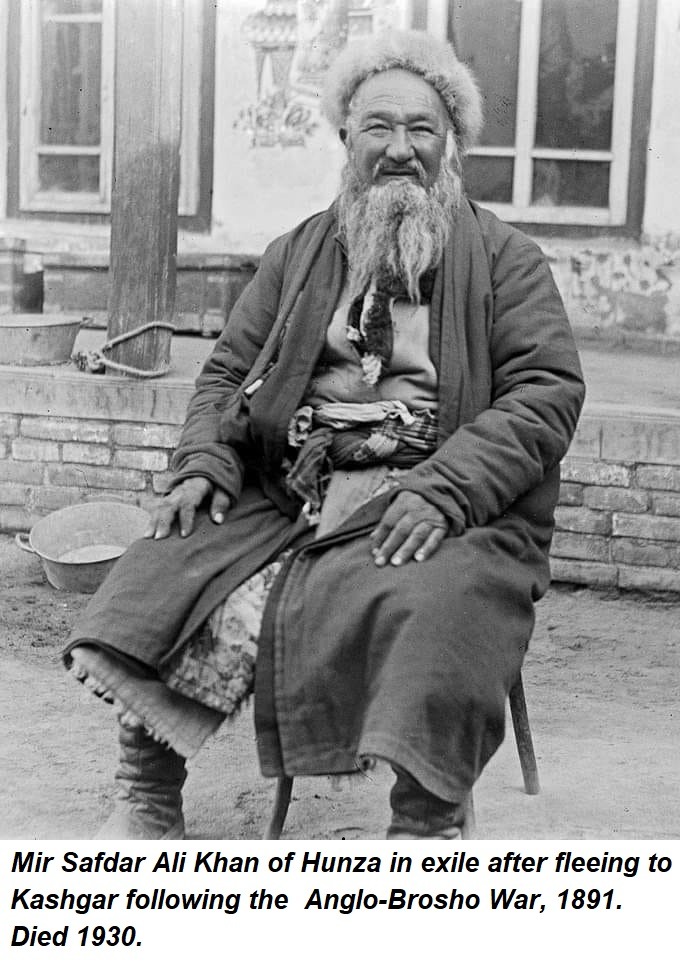
His approach was different and much more successful than Biddulph’s. He tried to establish friendships with the chiefs whom he regarded as the natural leaders and diminish their fears while having the Maharaja augment their subsidies. In his discussions with the chiefs, he realized that Biddulph’s withdrawal had made them very cautious in dealing with the British. While he succeeded with the other Chiefs, not so with the Thum of Hunza. Ghazan Khan I who had been the ruler of Hunza since 1864. He had maintained good relations with Biddulph and allowed British officers like Col Lockhart to pass through his state. However, in 1886, he was murdered by his second son Safdar Ali who placed himself on the throne. According to Durand, he bore an ill name for treachery, cruelty, and weakness.
After a month-long visit to the Mehtar of Chitral and obtaining assurance from him that he pledged allegiance to the British and sought their protection, Durand proceeded to tour Nagar and Hunza. The stay in the latter was unpleasant because of the behavior of Safdar Ali who was demanding more presents and subsidies even though the Maharaja had agreed to grant the two neighboring states an annual allowance of Rs. 2,000. It was also stressful because, during Durand’s final night in Hunza, there loomed a threat of an attack on his camp. However, he managed to secure the promise of a passage for the famous explorer, (then) Capt Younghusband who was on his way to Gilgit from the Pamirs.
Apprehensive of the intentions of the Thum of Hunza and the negative effect that a revolt by him would have on the smaller principalities, Durand started building up the military strength in Gilgit as well as improving the communication towards Srinagar and up the valley of the River Hunza to the forward base of Chalt and outpost of Chiprot. He also improved the Gilgit garrison as well as its logistics. It was a timely effort because in 1891, the ruler of Nagar was deposed by his son Uzr Khan who gathered forces to attack Chalt and Chiprot. What followed is referred to as the Anglo-Brusso War by the end of which Durand’s forces had occupied both principalities and Uzr Khan and Safdar fled to Kashgar. The residence of the Thum of Hunza, was sacked by the soldiers and some of its treasures which had been collected over 5-6 centuries were on sale in the market of Gilgit.
Four years later, there was a political upheaval in Chitral following the death of the old ruler. A small British Garrison from Gilgit sent to intervene was besieged in the small fort in the town, and an expedition was mounted for its relief: a larger one from Peshawar and a smaller one from Gilgit. The military operations in Hunza-Nagar and Chitral were the only time the British used force of arms after which calm prevailed in this region. After the affair in Chitral had settled, it was transferred to the Malakand Agency. The Gilgit Agency now comprised the Gilgit wazarat or district, which was the city of Gilgit and its surrounding towns, and the princely states of Hunza, Nagar, to the east of Gilgit and Punial, Yasin, Kuh-Ghizar, and Ishkoman in the west. These areas were nominally under the suzerainty of Kashmir but were directly administered by the Agency.
With the Russian Revolution in 1917, British anxiety increased and Maharaja Gulab Singh was forced to lease the Gilgit Agency to the British in 1935 for a period of 60 years. The post of Political Officer was upgraded to that of a Political Agent, an officer of the Foreign and Political Department. Immediately after Independence, the British cancelled the lease thus transferring the powers of administering the Gilgit region back to the State of Kashmir. It was a parting stab in the back that led to military action in the region.
Author’s Note. I am grateful to Lt Col Nasir, HQ FCNA for sourcing old photographs of the residences of the Political Agents and much more information.
Bibliography
Books
Durand, Lt Col Algeron. Making of a Frontier. John Murray, London. 1899.
Military Report and Gazetteer of the Gilgit Agency. Second Edition. Government of India Press. 1928.
Hamid, Maj Gen Syed Shahid. Karakuram Hunza. Maare Ltd. Karachi. 1979.
Chohan, Amar Singh. The Gilgit Agency 1877-1935. Atlantic Publishers & Distributors, 1984.
Biddulph, Maj John. Tribes of the Hindoo Koosh. Government Printing Press. Calcutta, 1880.
Leitner, G. W. The Hunza and Nagar Handbook. Oriental University Institute, Woking, England. 1889.
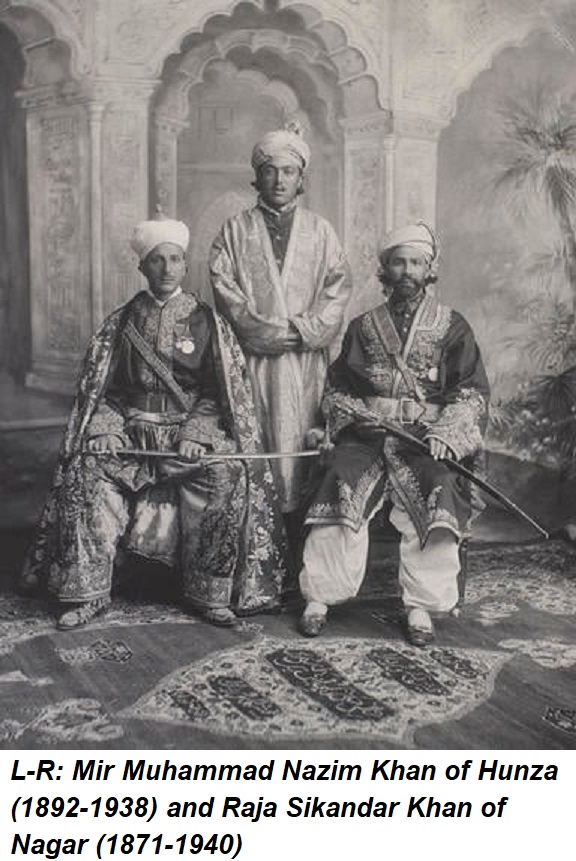
The Autobiography of Sir Mohomed Nazim Khan KCIE. Mir of Hunza. 1892-1838. Privately published by his grandson Mir Jamal Khan.
Articles
Sheikh, Dr. Shabir Ahmad. British Intervention and the Case of British Agency: 1846-1892. Government Degree College Beerwah.
Sökefeld, Martin. From Colonialism to Postcolonial Colonialism: Changing Modes of Domination in the Northern Areas of Pakistan. Journal of Asian Studies, Vol. 64, No. 4. 2005.
Abbas, Zameer. Colonial Historiography, and Gilgit-Baltistan. The Karakorum. January 2023.
Shah Kriti M. The Kashmir that India Lost: A Historical Analysis of India’s Miscalculations on Gilgit Baltistan. Observer Research Foundation Occasional Paper No. 334, October 2021.