
The science of engineering military bridges also dates back two-and-a-half millenniums. In 480 BCE, the Phoenicians constructed a pontoon bridge for the Persian Army to cross over the Dardanelles. In his Anabasis of Alexander, the Greek historian Arrian credits Alexander with constructing a bridge of boats across the Indus and believed that the skeleton framework was of huge wicker baskets. However other historian state that it was constructed of boats which were subsequently cut into smaller sections and transported to the River Jhelum. The Roman engineers were also skilled at crossing large waterways and during the Gallic War of 55-53 BCE, they constructed wooden beam bridges across the Rhine for the army of Julius Ceaser.
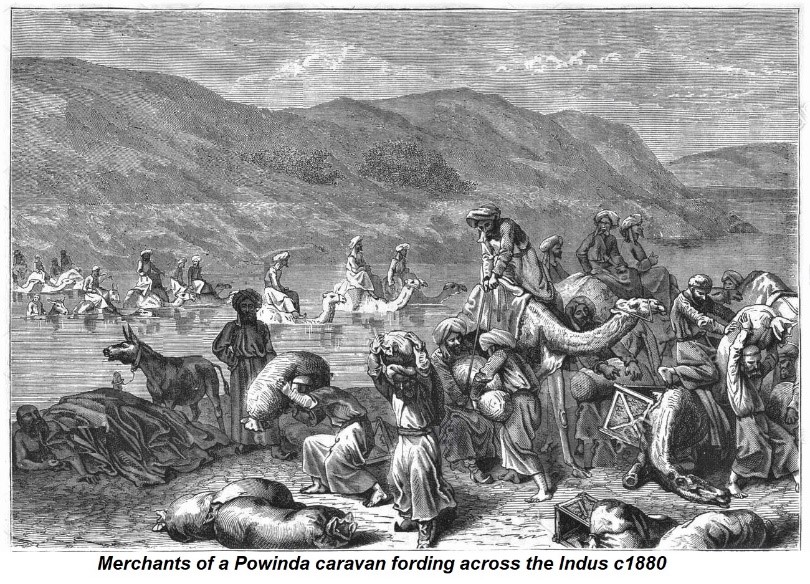
Armies on the march in Northern India crossed rivers either by ferry or fords or boat bridges. The last two options were possible only in the dry months when the rivers generally shrank to one-third their size and volume, and that is why it was feasible to campaign during these months. Alexander forded the Indus at Hund in the winter months and fought Porus on the banks of the Jhelum in May. However, as he penetrated further into the land of five major rivers during the monsoons, his army nearly rebelled.
All 17 of Mahmud of Ghazani’s campaigns in India were during winter and Emperor Babur crossed into India in early 1526 and fought the First Battle of Panipat in April that year. The Second Battle of Panipat was fought in November 1556 and the third between Ahmed Shah Durrani and the Marattha Empire was fought in January 1761. Like Mahmud of Ghazni, all nine of Durrani’s campaigns into the Punjab were during the dry season from September/October till May/June.
After Alexander’s boat bridge at Attock, the next recorded evidence I found of a boat bridge over the Indus is during Taimur’s invasion of India in 1398. He crossed the river east of Bannu over a bridge built of boats and three legged trestles that was constructed in two days. However, another source states that the bridge was made of rafts and bundles of reeds. The most famous of the crossings over the Indus with a boat bridge was at Khairabad (more popularly known as Attock after the fort) and became a permanent feature during the rule of the Mughal Emperors. In fact, the Mughal rulers went to extreme lengths to ensure that communication was uninterrupted as far as possible over all the rivers of the Punjab. In September 1652 heavy rains in the entire Indus plain flooded all the rivers and streams. A bridge of 40 boats was constructed at Jalala on the Indus, while 55, 56 and 50 boats were used to bridge the Jhelum, Chenab and Ravi respectively. Further down the province, a bridge of 104 boats was erected at Buh over the combined waters of the Beas and Sutlej.
Maharaja Ranjit Singh also periodically constructed a boat bridge over the Indus when the territory came under his control. A report by a British Engineer officer who crossed the Indus in 1839, provides a detailed description of the Bridge of Boats at Attock. The boats were owned by the Mallees who were brought to this site by Emperor Akbar 300 years before. The bridge could be constructed at two locations. Upstream it required 34 boats and was open till May but the one downstream could remain open till June because it was confined between steep banks and required between 17- 20 boats depending on the width of the channel. The bridge was assembled by a crew of 40-50 in 15 days but in an emergency it could be assembled in five days. The planks which made the road-way of the bridge were covered with mud and straw and the anchors were of wooden framework filled with stones, each weighing 1.5 tons.
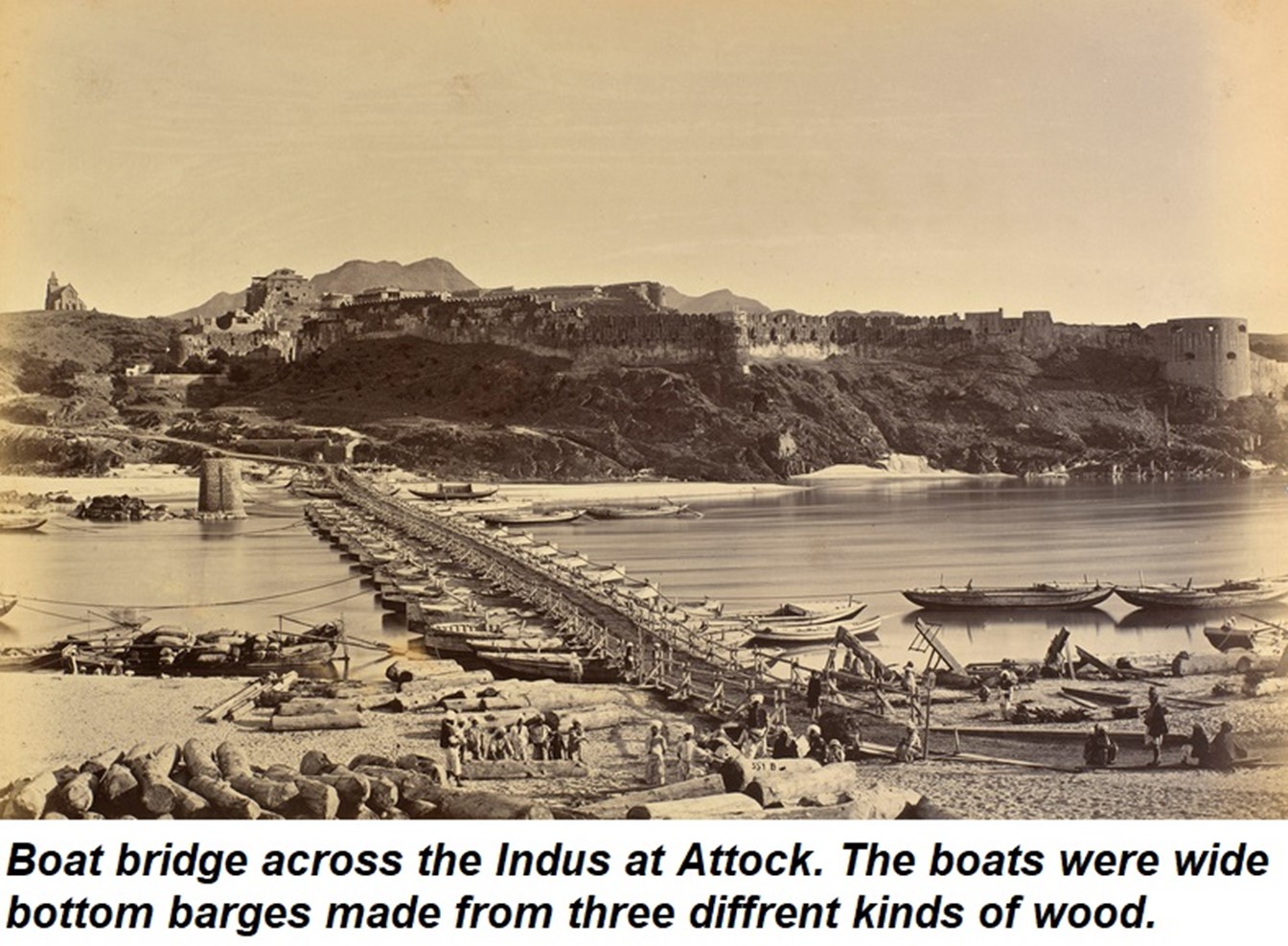
The Sikh Government had it built annually aft er the rainy season, around the 20th of October. When the bridge was operating, the Mallees were paid 4 annas (1/4 Rupee) a day per boat by Ranjit Singh’s government and they also earned by a toll of 4 annas for laden bullock carts and less for livestock and people. Camels could cross but elephants were not allowed over the bridge. Four of these boats were used to ply a ferry between Khairabad and Attock and when the river was running high, each required a crew of 35-40. Each ferry could transport 250 infantry or 50 soldiers and 12 horses.
The same British officer records that the Indus could only be forded between Attock and Tarbela at five places but another mentions nine. Of the five fords, the two closest to Attock were manageable only in the month of January and in one of them which had only two channels, the water was breast high. Eighteen kilometers upstream was the third and only ford which was available throughout the year except from May till October when rain and snow melt swelled the river.
Over the centuries many armies crossed the Indus from these fords of which the most well-known was the one at Hund. In more recent times, the Indus was forced by Rajit Singh in the spring of 1823 but with near disastrous consequences. He had earlier sent an army to evict the Afghans from Peshawar, but when the Afghans demolished the bridge at Attock, the Sikh army was trapped near Nowshera. Desperate to relive this force and rescue his son who was in command, Ranjit Singh brought up his army opposite Hund. On the opposite bank, a lashkar of thousands of fighters led by Syed Ahmad Shah of Buner had started forming. Fortunately, the spring rains had been delayed and though under fierce attacks, Ranjit Singh forded the Indus at night. The guns were transported across on the back of the elephants and the soldiers joined hands and crossed with their accoutrements on their heads. However, he lost close to 7,000 men in effecting a passage.
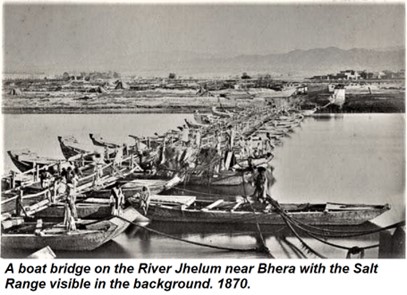
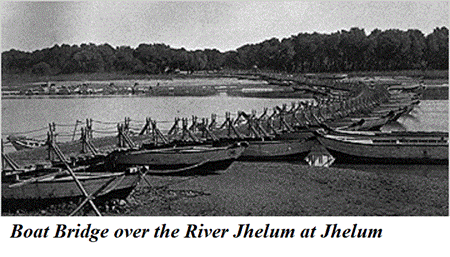
Like the other rivers of northern India, successive governments as well as armies also bridged the Jhelum with boats. According to one of the early Gazetteers of Jhelum District, the river formed a single broad channel during summers and two narrower ones in winter. Like on other rivers, the boat-bridge had to be removed when the flow became quicker in April and re-installed sometime in October. The common flat-bottomed river craft were used on 13 ferries that existed on the river passing through the district. During very severe monsoon floods, even the ferries had to be suspended and travelers had to wait days on end.
When a boat bridge was not available, the River Jhelum had to be forded with great care even during the dry season. Currents in places would be fast and the water very cold. When part of the Army of the Indus was returning from Afghanistan in December 1840, 16th Lancers started fording the river close to the town. A reconnaissance team had reported that the depth of water was chest high and not too deep for cavalry to ford. Stakes had been driven to mark the direction of the ford and the adjutant had ridden across, and back announcing it to be practicable. The regiment entered the ford in threes but near the center, the sight of the stakes was lost because a convoy of camels were crossing simultaneously. The leading riders tried to pass from the right and ran into deep and fast flowing water. The Dragoons were in full marching order and their horses were carrying a lot of weight. To their alarm, the observers on the far bank saw horse after horse with their riders disappear and suddenly rise again. Giving the horses their head, many riders managed to reach the shore. Boats were dispatched to assist those who were in serious trouble but could not arrive in time and an officer, a corporal and nine privates and their horses drowned. The remainder of the regiment averted the danger by taking another ford upstream.
When the British Army of Bengal under General Sir Hugh Gough was pursuing the remnants of the Sikh Army northwards after the battle of Gujrat in 1849, they found the river Jhelum in an unseasonal flood in February. With the tragedy that had befallen 16th Lancers only nine years previously still in their minds, the British were much more careful. A crossing site was selected some 13 km upstream near the fort of Mangla, where the river divided into five parallel streams. The main stream was only a 100 meters wide but was flowing with great velocity as the waters exited the mountains. To maintain the momentum of the pursuit the cavalry and infantry forded across but with great care and after a great deal of bandobast for safety. However, the guns and stores waited for a boat bridge which was constructed with great difficulty over the largest of the streams.
Unlike the Jhelum, the Chenab was very wide. In fact, it was the widest and most tortures river of the Punjab. It rises in the Himalayas, and reaches Wazirabad after a course of about 1120 km and then before the channels were trained it wandered unchecked through the plain. During the winter the river was contained in a main channel about 450 meters wide and 3-5 meters deep. However, during floods, it rose 3 meters above the low-water mark, and its width increased up to 5 km. Moving at a rate exceeding 10 knots the depth of the main current was 15 meters.
In the first half of 1850s, when the GT road was extended towards Jhelum, a massive embankment raised above flood-level was constructed to carry the road as far as possible across the river bed. The rest of the way it ran over boat bridges on the varying channels, connected by temporary roads of timber and fascines laid on the sandbanks. These bridges and roads lasted, though with constant interruptions, for about eight months in the year. During the remaining four months, a ferry was established, which frequently necessitated a day’s voyage in order to go from shore to shore. During high floods the ferry was suspended altogether. After the completion of the Alexandra Railway Bridge over the Chenab, around 1880, the boat bridge was replaced by a steamer ferry to transport road traffic.
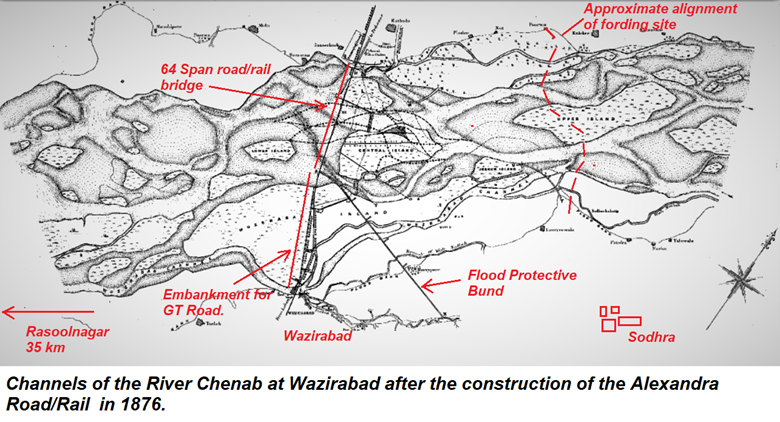
Before this alignment of the GT Road, the Chenab could be crossed at many locations between Sodhra and Rasoolnagar. While other fords constantly shifted, the ones opposite Sodhra and another at Ramnagar were constant. Sodhra or Sohdra is located 5 km above Wazirabad and is a place of some antiquity with the town having been founded during the period of Mahmud of Ghazni. The Gazetteer of Gujrat states that part of the River Chenab which divides the District of Gujrat from Gujranwala was known to Muslim historians as the Sudhara.
During most of his campaigns into Punjab, Ahmed Shah Durrani crossed the Chenab at Sodhra without any incident. However, in December 1764, while hastening back to quell an insurrection in Afghanistan, he was informed that it was easier to ford the river upstream where it was divided into eight channels. he made the mistake of crossing upstream closer to the hills. It was a bad mistake. The army moved to that point and crossed six of the eight channels. However, the remaining two were very deep and swift and violent and were overflowing. When the army and the baggage entered into these streams, the strong currents carried away many laden camels and saddled horses and innumerable donkeys, bullocks, buffalos, tents and treasures, as well as 1000 men and women. It is surprising that Durrani took this risk because 25 years earlier in 1739 his previous mentor Nadir Shah had attempted to cross the Chenab near Akhnur over a bridge of boats in the month of June. Though the boats were anchored with steel chains, the bridge broke due to a sudden inflow of water leading to the death of 2,000 soldiers.
Like Sodhra, Rasoolnagar which during the Sikh era was called Ramnagar, is also a place of some antiquity. British troops made frequent use of the fords at Rasoolnagar and after the accident on the Jhelum in December 1840, the Army of the Indus used this ford to cross the Chenab. To arrive at the main channel, the troops had to cross over heavy sand for 2 km, at the end of which there were four channels 1½ meters deep with water on the rise. The Ghat on the main channel was good, with low banks and there were 14 large and some smaller boats that the British used for ferrying. After their losses on the Jhelum, 16th Lancers and the rest of the cavalry was extra careful. The baggage, was sent across during the afternoon, and the main body crossed the river next morning. The troopers with their saddles, etc. were sent by the ferry and the horses unencumbered by any weight and in the charge of the syces forded across. Similarly, the Artillery horses were sent by the ford and the men, guns, harnesses and saddles by the ferry.
It was on the banks of the Chenab in the vicinity of Rasoolnagar that the army of Lord Gogh was first confronted by the troops of Sher Singh in December 1848. During this period, the river was 200 meters broad and flowed in two main channels with an island in between. One channel was 4.5 meters deep and the second 3 meters. As summer approached, the crossing became difficult. Around the same period, a British traveler coming from the direction of Pind Dadan Khan in May, had to cross several deep channels before he could board the ferry. The river was very wide and it took him four hours to get across.
During the Anglo-Sikh Wars, the British found the quality of boats on the ferries was weak. Therefore, after they annexed the Punjab, a program was initiated to build an efficient fleet of boats to bridge the rivers in winter and serve as ferries in the rainy season with adequate mooring chains and anchors. Fortunately for the British, most of the boat bridges had been opened for traffic a year before the revolt of 1857.
After 1857, an effort was made to shorten the river crossing with embankments, fascines and metaled roads. The annual cost of maintaining these bridges amounted to Rs. 200,000 but not all the boats used in the bridges belonged to the government. While all the 31 boats at the 370 meter bridge on the Ravi at Shahdara belonged to the government, at the 770 meters bridge at Wazirabad on the Chenab, 33 were of the government and 24 were private. The relatively shorter bridge on the Jhelum of 300 meters had only 6 boats of the government while 23 were owned privately. On the 400 meter crossing of the Indus at Attock except for two boats all the rest of the 38 were owned by the government. The bridge at Shahdara was the only one that remained during the monsoons. All the others were dismantled and the boats used as ferries.
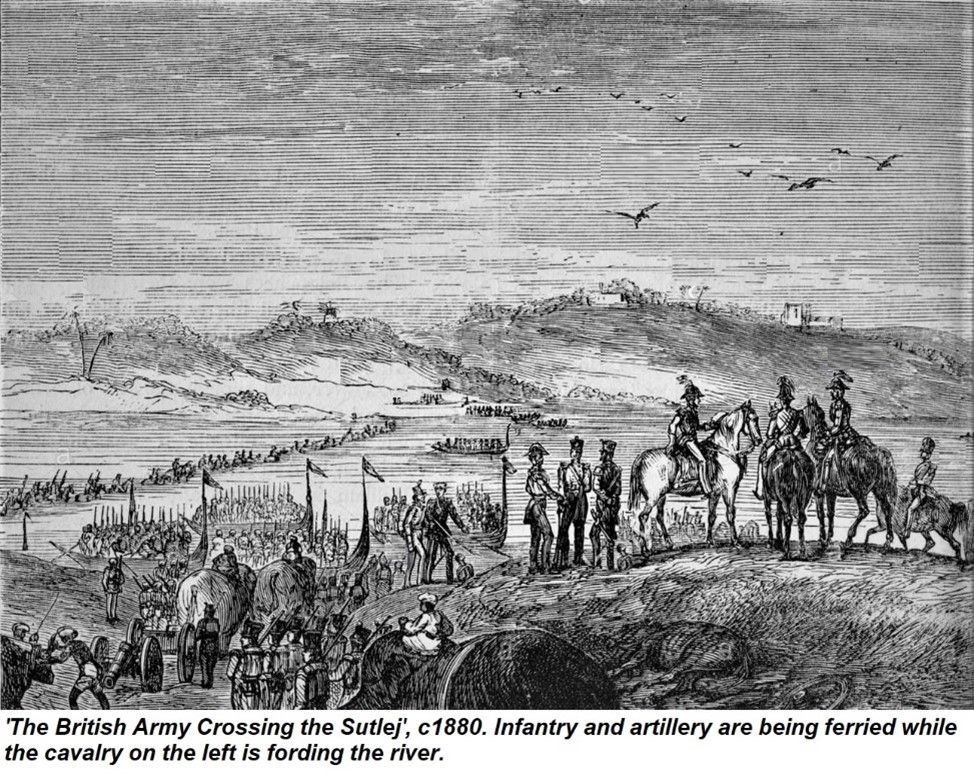
As the network of road and rail bridges spread through the Punjab and into the northwest frontier of British India, the boat bridges and ferries became redundant. In 1884 the road/rail bridge at Attock was completed and the boat bridge was discontinued. The same year the ones along the GT over the Jhelum and Chenab were also discontinued and ferry trains substituted in their place. But at other locations boat bridges continued to be erected during the dry season. I remember during the 1950s/60s, it was such a treat to drive over one on the River Kabul near Nowshera and hear the rattle of the planks as the car passed over.